

A small red felt square, which has represented student resistance in Quebec for over ten years, is making a comeback on campuses across Ontario this week.
On Monday, volunteers distributed red squares secured with safety pins at the Student Life Centre of the University of Waterloo.
Organizers termed the occasion “red square day,” coinciding with a large-scale protest scheduled for Wednesday aimed at urging the provincial government to retract its proposed modifications to the Ontario Student Assistance Program (OSAP).
Damian Mikhail, the president of the Waterloo Undergraduate Student Association (WUSA), received a red square pin from the volunteers on Monday.
“The red square signifies my belief that education should not be restricted by one’s financial status or family background,” Mikhail shared with CBC News.
“Everyone deserves the opportunity to pursue the life they aspire to, or at least have a fair chance at it.”
Red squares were also given out at Wilfrid Laurier University’s Waterloo campus on Monday afternoon.
Nora Schwindt, a sociology student at Laurier who manages a protest page on Instagram, noted that the red square was selected “due to the protests in Quebec during 2011/2012 against a similar issue.”
“We are adopting this emblem because they succeeded in opposing the government and reversing those changes,” Schwindt explained. “The symbol is already recognized, and we hope that will aid our cause.”
An Instagram account named Ontario Protest indicated that red square days were organized at various other campuses on Monday, including the University of Ottawa, McMaster University in Hamilton, Brock University in St. Catharines, Humber College in Toronto, Western University in London, Toronto Metropolitan University, and Durham College in Oshawa. The Central Student Association at the University of Guelph planned to host an event on Tuesday.

Ontario Premier Doug Ford states that he has received thousands of complaints since the province announced significant changes to its OSAP program. He is advising students to avoid “basket-weaving courses” and instead pursue education that leads to high-demand jobs, such as those in healthcare or trades.
Premier Doug Ford announced the reductions to OSAP at the end of last month, with plans for implementation this fall.
Under the new framework, grants will constitute only 25 percent of total financial assistance, while loans will account for 75 percent. This represents a significant change from the former structure, where students received up to 85 percent of their support in grants and only 15 percent in loans.
Nolan Quinn, Minister of Colleges, Universities, Research, Excellence and Security, stated to CBC News that the changes represent an investment, asserting that the advantages of post-secondary education outweigh the financial burdens.
“For me, it’s a worthwhile expenditure from the student’s perspective,” Quinn remarked.
Some students in the Waterloo area who are either attending or applying for post-secondary education expressed to CBC K-W’s The Morning Edition their feelings of “discouragement” regarding the OSAP reductions.
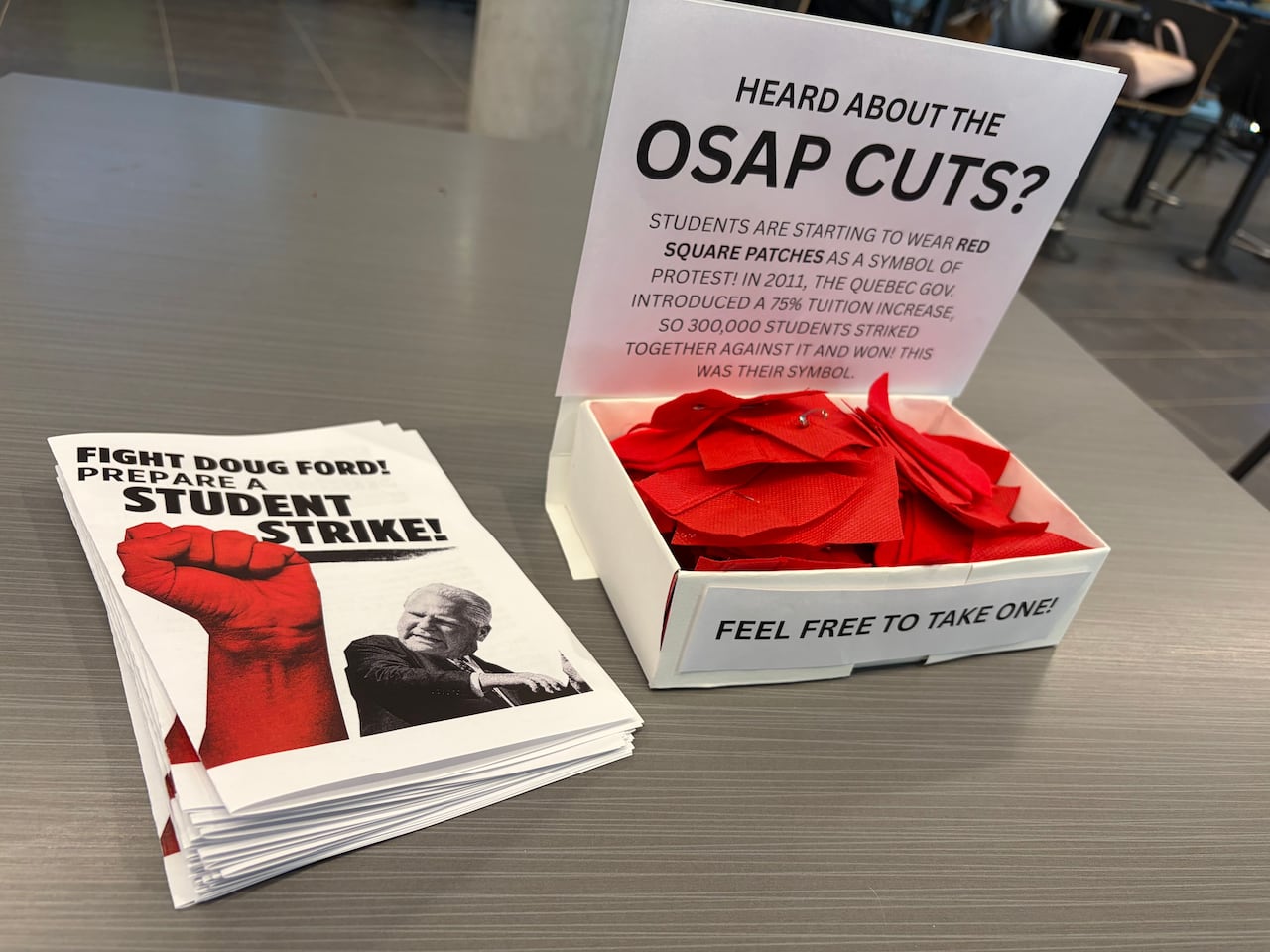
At the University of Waterloo, students distributed red square pins and pamphlets advocating for a student strike (J.P. Webster/CBC)
History of Quebec protests
In February 2012, thousands of students across Quebec staged walkouts to protest against the province’s proposal to increase tuition fees.
They remained out of class until September.
Throughout seven months of ongoing protests, the red square emerged as a significant symbol that students displayed on their clothing, flags, and signs.

Students at the University of Waterloo were distributing red squares yesterday. It’s intended to draw attention to concerns regarding the province’s cuts to OSAP grants. This was all part of an initiative to garner support for a province-wide student protest on Wednesday.
Vincent Raynauld, an associate professor in the communication studies department at Emerson College in Boston, who grew up in Quebec and specializes in political movements and protests, remembers the red square as a “rallying cry” for students who were unhappy with tuition increases that hindered their ability to afford education.
The University of Waterloo’s Ontario Protest Instagram account explained the significance of the red square as symbolizing being “squarely in the red,” a phrase reflecting the debt students fear accumulating.
Raynauld noted that it is not surprising to see the red square reemerge in Ontario after 14 years.
“I’m not surprised that this group of students would be using the red square as a new rallying symbol to encourage people to respond to what are perceived as harmful actions toward students in Ontario,” Raynauld mentioned.
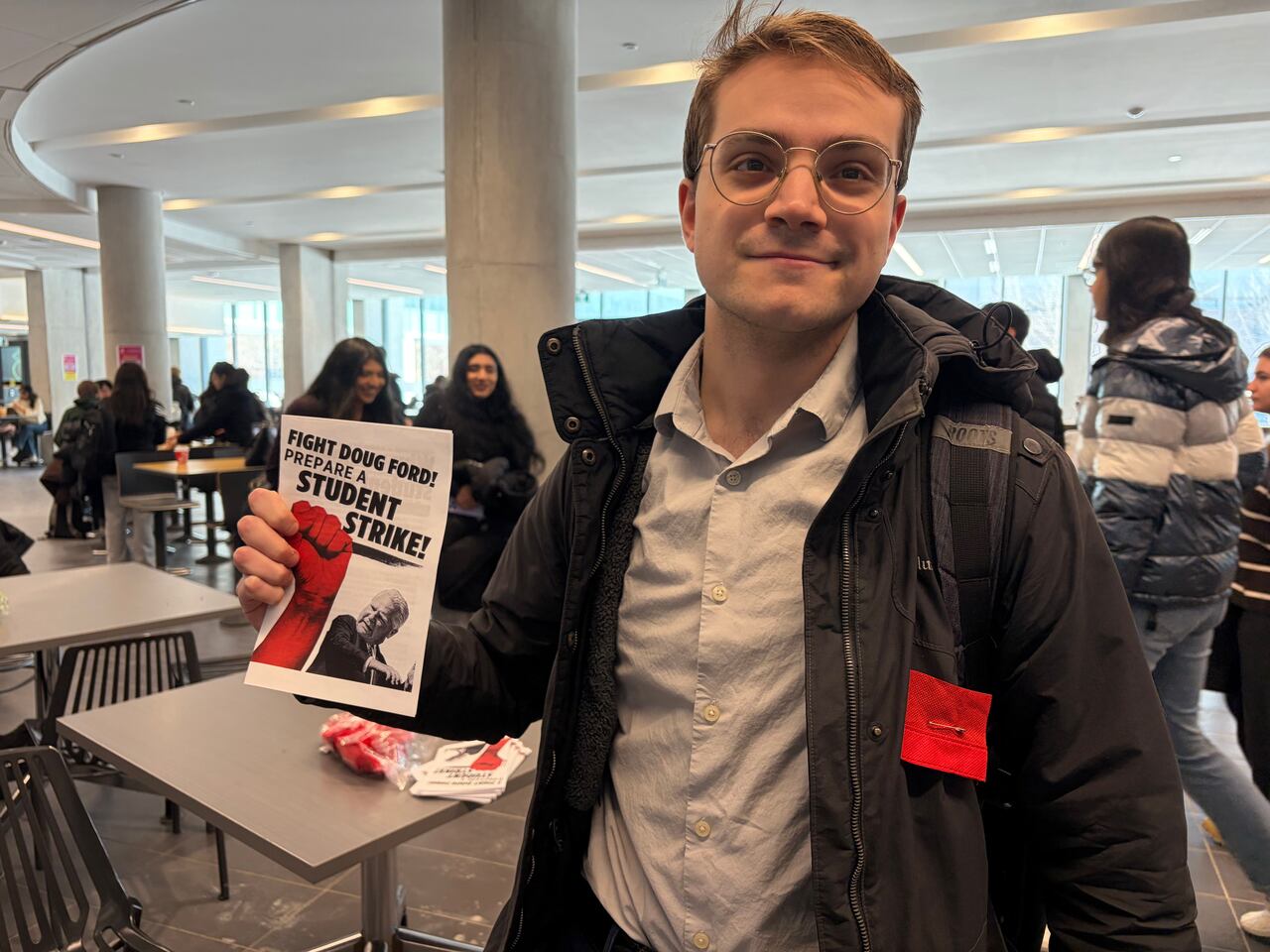
Gabe Gorbet, one of the students distributing red squares at the University of Waterloo on Monday, states that “education is the lifeblood of the youth.” (J.P. Webster/CBC)
Walkouts planned
On Wednesday, hundreds of students are anticipated to gather at Queen’s Park in Toronto, many adorned with red squares.
Student unions from across the province are urging students to travel to Toronto for the rally or to organize their own demonstrations in solidarity.
The Central Student Association at the University of Guelph and Conestoga Students Inc. have expressed their support for the Toronto rally on their Instagram accounts.
The Laurier Student Union is motivating students to participate in the movement. Schwindt mentioned that some students from Laurier are planning to attend the rally in Toronto.
WUSA conducted a vote regarding the proposal for a student strike. Out of 3,536 students who voted — slightly over 10 percent of the eligible voters — it was revealed on Monday that 94 percent supported the strike action.
Consequently, students plan to walk out of their classes at 11 a.m. on Wednesday and gather near the Dana Porter Library for a rally.
“There is a history of students making their voices heard and governments responding to that,” Mikhail stated.
“It’s vital to continue this legacy and demonstrate that change is possible … and that students can make their voices count in significant ways.”