

Several public servants in Nova Scotia with scientific knowledge have reported feeling restricted and pressured to dilute environmental evaluations of onshore wind development projects, as revealed in a survey by the provincial auditor general.
Nova Scotia’s Auditor General, Kim Adair, published the survey results on Tuesday, which were part of an audit recommending that the government enhance its methods for conducting environmental assessments on new initiatives.
Environmental assessments are performed by governments to allow scientists and other specialists to assess the impacts of industrial activities and decide on measures to mitigate those effects.
However, Adair’s latest audit included information from a survey of public servants who claimed that the government was stifling the advice from its own experts during these evaluations.
“For instance, individual respondents conveyed feelings of being ‘muzzled,’ receiving ‘directions’ not to propose terms and conditions, or experiencing pressure to ‘modify or soften’ their feedback,” the report noted.
-
N.S. launches call for more onshore wind in final push to meet 2030 target
-
Nova Scotia approves plans for the province’s largest onshore wind farm
The auditor general’s office indicated that they surveyed 136 individuals involved in environmental assessments within the government, with 38 respondents who had participated in the assessment of onshore wind projects since 2023.
The audit also highlighted how public servants pointed out potential risks in certain projects that were not acknowledged in the official government approvals.
“For instance, in one project, government reviewers noted risks to the endangered wood turtle and lichen habitats that were not addressed by the project proponent,” Adair stated in the audit. “In another instance, reviewers expressed concerns that the project owner failed to consider the heightened risk of wildfires. We found no related terms and conditions in the approval that would mitigate these risks highlighted by the experts.”
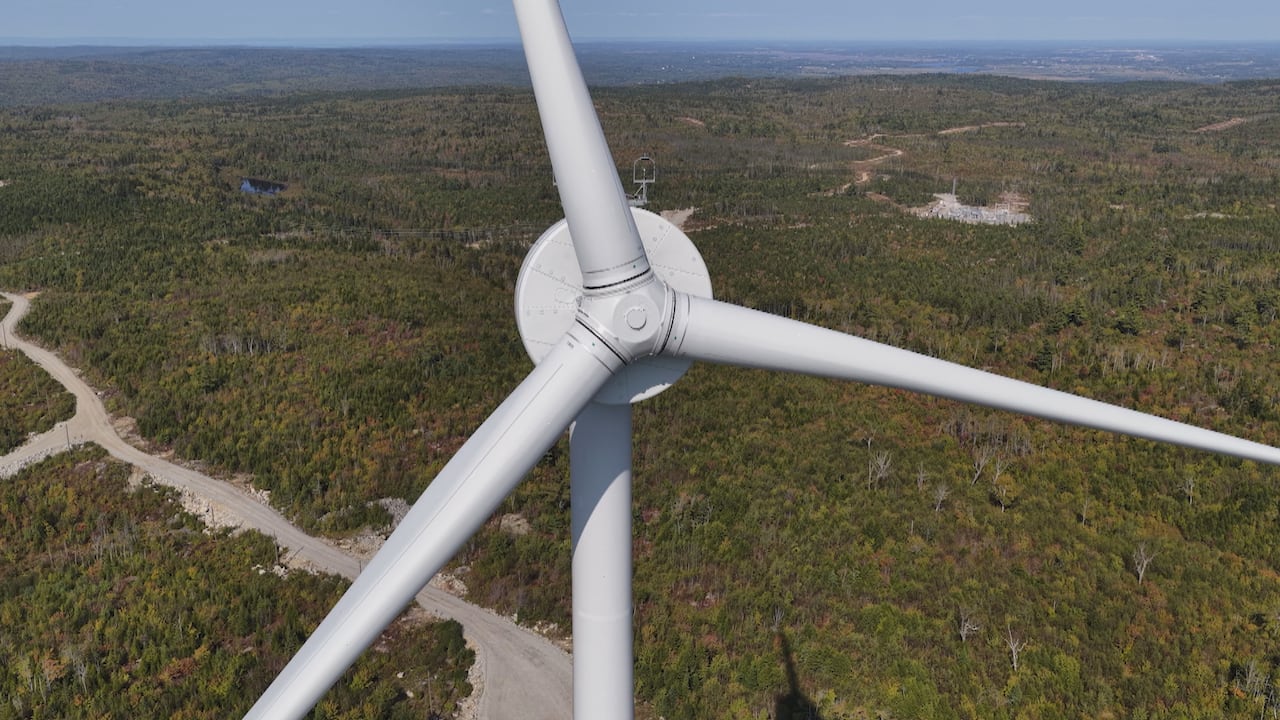
A turbine at the Benjamins Mill Wind Project in Hants County, N.S. (Brian MacKay/CBC)
Adair proposed 13 recommendations intended to enhance the environmental assessment process and the monitoring of compliance post-approval. The provincial Environment Department acknowledged all of the recommendations made in her report.
“It’s troubling to hear from government reviewers that they feel muzzled or discouraged from voicing their concerns. This was a recurring theme during our investigation, which is very alarming,” Adair expressed during a news conference on Tuesday.
Environment Minister Tim Halman defended the province’s environmental approval process, asserting that “decisions are made rigorously and based on science, facts, and evidence” in an email statement on Tuesday.
He did not address the allegations concerning the alleged suppression of government reviewers directly but emphasized that reviewers conduct “incredible and important work” to ensure he can make well-informed decisions.
The auditor general’s report indicated that Nova Scotia’s environmental assessment process aligns generally with those of other provinces.
Adair pointed out that several issues raised in this latest report had been highlighted during her office’s previous review of this process in 2017, and those matters were resolved by the time of her follow-up in 2020.
However, she noted that this is no longer the situation.
“This audit shows that there has been a regression or backtracking, which I find very troubling,” she remarked.
Adair stressed the importance of effective environmental oversight, especially as Nova Scotia relies on onshore wind energy to achieve its renewable energy goals by 2030.
Currently, over 300 commercial wind turbines operate across Nova Scotia. By 2025, these turbines were expected to generate roughly 17 percent of the province’s total electricity output. These wind farms are owned by Nova Scotia Power, community organizations, and independent energy producers.
The auditor general stated that, once a project receives approval, the department fails to adequately monitor it to ensure compliance with terms established to manage environmental risks.
The report’s recommendations include enhancing environmental assessment terms by incorporating measurable criteria with clearly defined timelines and requiring staff to document their rationale when reviewer feedback is not integrated into the assessment conditions.
In addition, Adair emphasized that the department should verify the qualifications of external consultants involved in the assessments.
NDP member Lisa Lachance expressed on Tuesday that the audit raises significant concerns, indicating that Nova Scotians cannot rely on the environmental assessment process.
“The experts, our public servants, are not being permitted to perform their roles effectively. Their recommendations are being disregarded and suppressed,” Lachance told reporters on Tuesday.
Lachance remarked that Nova Scotians have valid worries regarding the impacts of energy project development on the province’s land, water, and wildlife.
“This government appears intent on hastily advancing without establishing trust and conducting thorough due diligence. I believe the environment minister is failing in his responsibilities by not adhering to a proper environmental assessment process,” Lachance stated.
Interim Liberal Leader Iain Rankin commented that the absence of compliance monitoring undermines the entire system.
“Environmental assessments are only as effective as their enforcement allows,” he told reporters on Tuesday.
MORE TOP STORIES
-
Dartmouth councillor wants cleanup plan for discarded drug gear piling up at city parks
-
Settlement approved in N.S. First Nation class action over non-consensual MRI scans
-
Man accused of threatening N.S. chief medical officer and daughter agrees to peace bond
-
N.S. government to hold livestreamed information sessions about data centres
-
Halifax broadcaster Todd Veinotte dies at 57