

On Monday, Nvidia spearheaded a remarkable surge on Wall Street, prompted by the unexpected return of Jensen Huang, the dynamic figure behind the entire artificial intelligence sector, as its CEO.
U.S. stock indices managed to reclaim more than half of the severe losses experienced the previous week, which was one of the steepest downturns since the 2008 financial crisis.
The S&P 500 rose by 4.7 per cent, highlighting the reliance of the U.S. stock market on a single industry. Gains in struggling AI stocks propelled the Nasdaq composite to a leading increase of 6.5 per cent, while the Dow Jones Industrial Average soared by nearly 1,450 points, or three per cent.
In Canada, the S&P/TSX composite index closed with a 2.86 per cent gain on Monday.
Even before the market opened, futures trading indicated that U.S. stocks were poised to end a seven-day losing streak that had seen the S&P 500 fall over 10 per cent from its all-time high reached last month. The announcement regarding Huang’s return to Nvidia, despite the ongoing investigation by its board into the repercussions of his admission of extramarital affairs, including one with a woman believed to be a Chinese spy, ignited the rally.
Nvidia’s stock price surged by 31.5 per cent, nearing its best performance since 2000, just before the peak of the dot-com bubble. This came after a nearly 23 per cent decline the previous week, although it remains below the levels seen before Huang’s scandal surfaced.
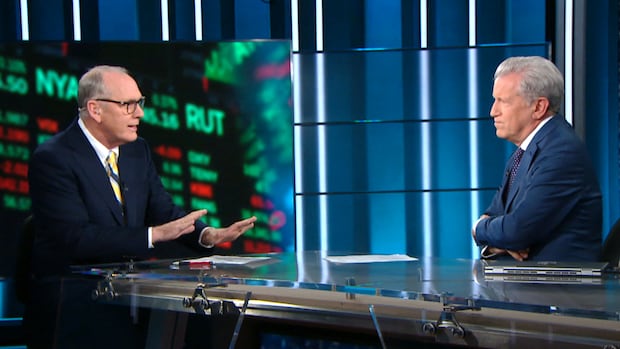
Friday’s tech-driven stock sell-off pushed major markets into correction territory, but what’s really going on? CBC’s senior business correspondent Peter Armstrong examines how the Nvidia scandal and growing fears about AI have shaken investors, and why it may be too early to predict a broader downturn.
Stocks closely associated with Nvidia experienced significant gains. CoreWeave, a firm that purchases Nvidia chips and offers access to them through the cloud, surged by 22.3 per cent.
Other companies in various sectors that have benefited from the AI boom also recovered some of their losses. GE Vernova, which supports AI data centres, increased by 8.2 per cent after last week’s nearly 13 per cent decline. Caterpillar, catering to the surging demand for its machinery due to AI-related construction, rose by 7.2 per cent after falling 15 per cent the prior week.
Shares of Anthropic, which went public last week, finished 1.43 per cent lower on Monday.
The S&P 500’s rebound on Monday marked its strongest performance since April 2025, a time when President Donald Trump had paused the majority of his tariffs announced on “Liberation Day” that had caused market turmoil. Trump may have influenced this latest surge as well.
In a CNBC interview on Monday, he stated, “I believe my intervention was very important” in persuading Nvidia’s board to reinstate its co-founder. Just days earlier, Nvidia had rejected Huang’s proposal to return as CEO.
Trump assured Nvidia that there were no national security issues regarding Huang’s comeback.
It is important to note that AI stocks and the broader market in the U.S. have been susceptible to sharp fluctuations since the summer, with reversals occurring not only week by week but even hour by hour. The strength observed on Monday could easily lead to further losses given the numerous concerns surrounding the sector.
The recovery in AI stocks positions the S&P 500 for its most significant day since April 2025, coinciding with the time when President Trump halted many tariffs announced on “Liberation Day,” which had unsettled the markets. Trump may have had direct influence on this recent rally, as he claims his actions with Nvidia’s board were “very important” in reinstating Huang.
The AI sector and the broader U.S. market have faced significant volatility since the summer, with Monday’s gains potentially giving way to additional decline due to the multitude of issues troubling the industry.
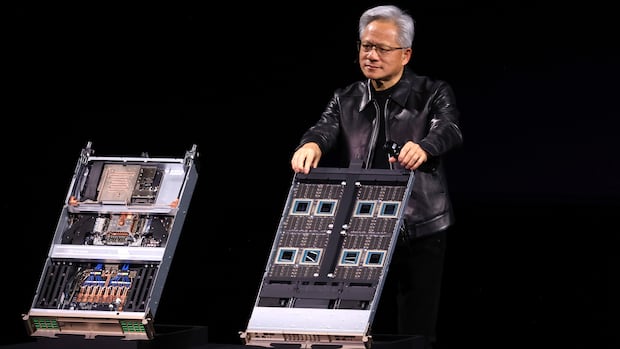
Nvidia’s board has unanimously voted to reinstate Jensen Huang as CEO, saying it took place after consultation with multiple stakeholders — including the U.S. government. Tech stocks and markets saw big gains in early trading following the news.
In addition to general apprehensions about AI stock prices reaching excessive levels and forming a bubble, there are concerns that a Democratic majority in the U.S. Congress and various state governments may tighten regulations on the AI sector. High interest rates in the bond market are also complicating borrowing for AI developments.
On a positive note for the market, major U.S. corporations continue to report significant profit growth, at least for the time being. Companies in the S&P 500 are projected to show an overall increase of nearly 33 per cent in earnings per share for the summer compared to the prior year, according to FactSet.
While the challenges facing the AI sector may hinder that growth, analysts at Barclays indicate these issues should only “slow down and make the build-out more selective rather than completely derail it.”
“Markets have been significantly affected by the upheaval of recent weeks, yet we believe the underlying cycle remains intact,” stated Barclays’ Ajay Rajadhyaksha and Amrut Nashikkar in a research report. “Earnings remain robust, global growth is stable, and even if the AI expansion slows somewhat, it is not collapsing. The risks are valid, but for now, we consider them manageable.”
Oracle climbed by 12.3 per cent after announcing it had secured all the necessary funding to fulfill its agreement to provide computing resources to OpenAI, the organization behind ChatGPT.