

Following the defection of another opposition MP to the Liberal Party, Prime Minister Mark Carney could be on the verge of achieving a slim majority after several upcoming byelections. However, the Liberal agenda may still encounter challenges in the House of Commons.
On Tuesday evening, Nunavut MP Lori Idlout switched from the NDP, increasing the Liberal Party’s seat count to 170, which is just two seats short of a majority.
Three byelections are set to take place next month.
Two of these contests are nearly assured to be won by the Liberals, as they fill vacancies in Toronto left by former cabinet ministers Bill Blair and Chrystia Freeland, ridings recognized as party strongholds.
Although 172 seats would grant the Liberals a majority, they would effectively be in a tie with the other opposition parties. Consequently, they would likely need the backing of at least one opposition MP to either vote alongside them or abstain to secure a victory or depend on the Speaker to resolve any tie.
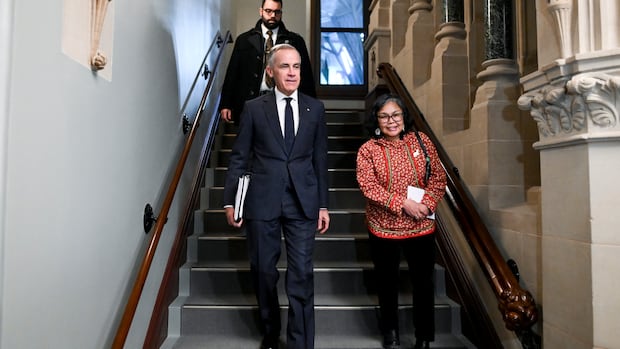
After leaving the NDP to join the government, Nunavut MP Lori Idlout entered the Liberal caucus with Prime Minister Mark Carney on Wednesday. When asked about her motivations for the switch, Idlout stated there were a ‘variety’ of reasons behind her decision.
Despite being elected as a Liberal, Speaker Francis Scarpaleggia is not obligated to vote in favor of the government.
The Speaker traditionally maintains impartiality and does not align with a party caucus once appointed by their colleagues.

Speaker Geoff Regan had to cast a vote when an unusual tie occurred in the House of Commons today.
As noted in the House’s official guidelines for practice and procedure, the Speaker “typically votes to maintain the status quo,” which includes “preserving the possibility that the issue might be revisited in the future and resolved by a majority of the House.”
In confidence votes, where the government could collapse if it loses, Scarpaleggia would likely side with the Liberals to uphold the status quo and allow further debate.
Historically, a Speaker has had to vote on a confidence matter at least once. In 2005, Speaker Peter Milliken cast a tie-breaking vote on an amendment to the Liberal government’s budget, enabling the legislation to advance to second reading.
However, it remains uncertain how the Speaker would vote in a tie during the third reading of new legislation. There have been 12 occurrences of a Speaker casting a tie-breaking vote, but none has been on the final vote that determines a bill’s fate.
Former Speaker Geoff Regan was once required to vote on a bill after it returned to the House from committee. In that case, Regan voted to permit the bill to proceed and for “debate to continue” into a third reading.

Francis Scarpaleggia, Speaker of the House of Commons, is seen here in May 2025. Although he was elected as a Liberal, he is not obligated to break a tie in favor of the government. (Adrian Wyld/The Canadian Press)
“In another situation, it might lead me to vote no,” Regan remarked after casting the decisive vote.
The Liberals would also continue to depend on an opposition party to advance legislation through committees, where party representation has been determined based on the House’s makeup at the session’s commencement.
Currently, House committees show a fairly equal divide between Liberals and Conservatives, with each committee including one Bloc Québécois member who can influence votes.
Typically, committee compositions—except for the procedure and House affairs committee—could be reset if Parliament were prorogued, resulting in a new session’s start.
However, Carney is unable to take that route due to a motion passed in June that locked committee compositions for this Parliament’s duration.
It is possible that the June motion could be overturned by a subsequent motion, but the Speaker would likely vote against it as it would disrupt the status quo.
If the Liberals secure victories in all three byelections next month, they would gain one additional vote, reducing the likelihood of the Speaker having to intervene to break ties—though the government must ensure the availability of all MPs for voting.

The Bloc Québécois successfully contested a one-vote Liberal victory in the Montreal-area riding in 2025. Following a voter’s complaint about her mail-in ballot being returned, the case ascended to the Supreme Court. Voters will return to the polls on April 13 for a rematch between Liberal Tatiana Auguste and Bloc Québécois’s Nathalie Sinclair-Desgagné.
The byelection in Terrebonne, located in the Montreal area, is anticipated to be far more competitive than the contests in Toronto.
The Liberals won this riding by a single vote over the Bloc Québécois in last year’s election, but last month, the Supreme Court invalidated the initial result and mandated a new election due to a misprint on mail-in ballot envelopes.
In recent weeks, the Liberals have shown strong polling numbers nationally, but the Bloc has predominantly held this riding since the early 1990s. All three byelections are scheduled for April 13, with advance voting available from April 3 to 6.