

On Friday morning in Calgary, Mark Carney and Danielle Smith greeted each other with a handshake before signing and posing with copies of an “implementation agreement for the Canada-Alberta memorandum of understanding.” This eight-page document is intertwined with significant issues regarding climate change, resource management, economic autonomy, and national cohesion.
“This is a positive day for Alberta,” stated the Alberta premier. “And a positive day for Canada.”
The prime minister remarked that the day was focused on “fostering trust in a functioning Canada” — a nation “grounded in cooperative federalism, where we collaboratively and ambitiously work together to achieve our common goals.”
-
Carney and Smith reach energy deal that may initiate pipeline construction by 2027
-
Analysis
No clear path for referendum after court ruling for Danielle Smith and Alberta separatists
-
Carney asserts that Alberta’s best place is within Canada, amid controversy over a separation referendum
Perspectives may differ regarding Carney’s specific balance of pragmatism and ambition. However, he likely hopes to create a framework that can endure.
The central element of Friday’s implementation agreement is a new approach to pricing greenhouse gas emissions from major industrial sources — starting with Alberta, and likely extending to other provinces operating under the previous system.
This new pricing framework sparked competing claims from the involved parties.
A compromise measured in megatonnes
For Alberta, the new agreement aimed at securing a lower price than what was established in federal legislation. Conversely, the federal government sought to create a more robust framework for emissions pricing.
What Carney may have accomplished in this respect is notable. Nevertheless, he has also made considerable concessions, which could have serious implications — this new pricing structure follows the Carney administration’s decision to abandon plans for capping emissions in the oil and gas sector.
Rick Smith, president of the Canadian Climate Institute, stated that “the finalized Canada-Alberta MOU implementation agreement will place Canada’s target of net zero by 2050 well out of reach,” in a written statement.
According to the Pembina Institute, its modeling indicated that the carbon pricing scheme in the implementation agreement could lead to an increase of 230 megatonnes of greenhouse gas emissions over the next 15 years.
The federal government did not present any modeling of its own on Friday.
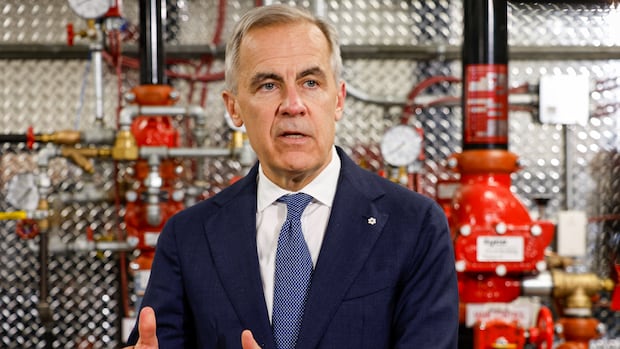
Prime Minister Mark Carney claims the new energy agreement with Alberta is a significant step toward achieving his government’s commitment to net zero emissions by 2050, and ‘more than compensates’ for emissions generated from oil extraction.
The previous policy established by Justin Trudeau’s government offered a stronger framework theoretically. However, Carney might contend that his approach is more effective in practice — especially since it was reached through political consensus with a conservative premier from Alberta.
When asked about the criticism his government faced on Friday, Carney seemed eager to highlight that he was securing “action” on climate initiatives.
Contrary to the federal benchmark, Smith’s administration had frozen the province’s industrial carbon price at $95 per tonne last year. (Simultaneously, Saskatchewan has halted the collection of an industrial carbon price entirely.) Due to inefficiencies in Alberta’s pricing structure, the effective price was significantly lower.
Alberta has now committed to increasing the headline price to $130 per tonne by 2035, with a legally mandated price floor reaching $100 by 2040. However, one might question whether Carney needed to make such extensive concessions to achieve these improvements.
Conservative Leader Pierre Poilievre continues to oppose the industrial carbon pricing, just as he appears to reject nearly all other federal initiatives aimed at cutting emissions. Recent events suggest it may be unwise to make too many predictions about Canada’s climate policy’s future.
Nonetheless, it is reasonable to speculate that the agreement announced on Friday — which includes financial provisions designed to support the industrial carbon price — may ultimately make it less probable that the next federal Conservative government will entirely eliminate the industrial emissions pricing.
Regardless, Carney now bears a greater responsibility to articulate how Canada can realistically achieve net zero emissions by 2050, a deadline that approaches with each passing day.
A referendum looms
For Carney and Smith’s memorandum of understanding, the next significant date to watch for is July 1, the deadline for submitting a proposal for a new pipeline to the West Coast. A private entity to propose that pipeline is still pending.
However, Carney reiterated on Friday that the pipeline’s advancement hinges on oil and gas companies consenting to proceed with the Pathways project for carbon capture and storage, which the oil industry has promoted since 2022.
Thus, the next challenge is whether an agreement can finally be reached to advance that project, and under what conditions. The wording in Friday’s agreement appeared to lower expectations regarding the extent to which Pathways will decrease industrial emissions.
In a statement released on Friday, the consortium of oil companies supporting the Pathways initiative asserted that the industrial carbon price, even at its reduced level, “maintains uncompetitive costs on the Canadian oil sands industry.” (The Climate Institute has estimated that an industrial carbon price of $130 per tonne would raise the cost of a barrel of oil by 50 cents.)
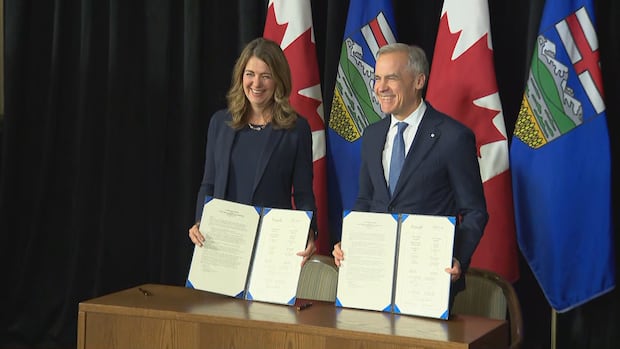
Prime Minister Mark Carney and Alberta Premier Danielle Smith signed an energy agreement in Calgary on Friday. The agreement builds on the memorandum of understanding signed last year.
However, in the backdrop of all this, the potential for a referendum in Alberta this fall looms — a divisive vote that would ask residents if they wish for their province to remain a part of Canada. This concern was the underlying tension that was somewhat hidden during Friday’s events.
In Carney’s prepared remarks, the themes of “trust” and “cooperation” were notably emphasized. At a news conference held by Smith, the initial inquiries focused on the possibility of a referendum.
“I believe this will significantly demonstrate that the new prime minister addresses cooperative federalism in a fundamentally different manner than his predecessor,” Smith commented. “While this may not influence everyone’s perspective, I believe it will convince some that Canada is worth defending and striving for.”
Ultimately, it’s likely that nothing Carney and Smith could have announced this week would entirely eradicate separatist sentiments in Alberta. Some individuals may have already made up their minds.
Nevertheless, Carney has made two trips to Alberta to collaborate with the premier and reach agreements. He has made compromises, making it more challenging to assert that the federal government is obstructing a pipeline.
At a minimum, such efforts are unlikely to have bolstered the separatist movement. They may have contributed positively to the unity of the nation.