

As the attention of the soccer community is predominantly on the men’s World Cup, the anticipation builds for the 2027 Women’s World Cup set to take place in Brazil.
Scheduled to kick off on June 24, 2027, this tournament will mark the first time a South American nation has hosted the women’s competition. Brazil previously held the men’s World Cup in 1950 and 2014.
“The host nation truly embodies the spirit of football. The enthusiasm from the fans, along with the teams arriving in Brazil, will be unparalleled; it’s a truly unique and remarkable country,” stated FIFA chief football officer Jill Ellis during an event in Miami on Wednesday. “I believe the same excitement felt now, when the globe unites, and showcases the remarkable quality of women’s football, will create an extraordinary spectacle of both the sport and its supporters.”
A countdown event took place not only in Miami but also in Rio de Janeiro. Additionally, at Wednesday’s World Cup match in Vancouver, British Columbia, between Switzerland and co-host Canada, digital signage promoted the upcoming women’s tournament.
The eight cities selected to host the women’s matches in 2027 also served as venues for men’s games in 2014: Rio de Janeiro, Belo Horizonte, Brasilia, Fortaleza, Porto Alegre, Recife, and Salvador.
The qualification process for the tournament is already underway. Brazil has secured an automatic entry as the host nation but has yet to claim victory in the women’s tournament. It remains uncertain whether Marta, a six-time FIFA world player of the year, will be part of the national squad. The 40-year-old has never won a major international championship.
Thirteen additional teams have qualified so far, including Australia, Philippines, Japan, North Korea, China, South Korea, Argentina, Colombia, New Zealand, Germany, France, Spain, and Denmark.
“Only one year remains until a historic moment for our nation. For the CBF (Brazilian soccer confederation) and all Brazilians, hosting the Women’s World Cup is a tremendous source of pride,” stated federation president Samir Xaud. “This event will allow us to demonstrate our love for football and, most importantly, the strength of Brazilian women’s soccer. We believe this World Cup will be transformative, inspiring girls throughout Brazil and creating a lasting legacy.”
The inaugural Women’s World Cup took place in China in 1991. The United States holds the record for the most titles, having won four times. Spain claimed the most recent title in 2023 during the tournament co-hosted by Australia and New Zealand.
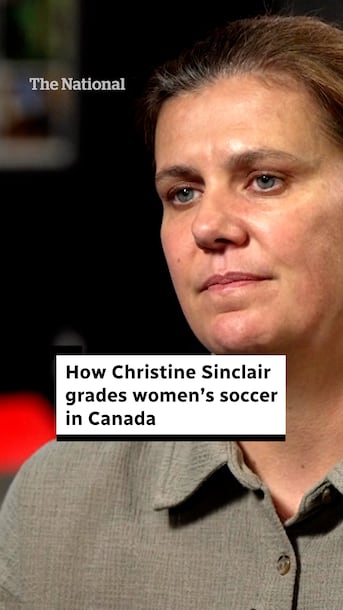
Canadian soccer legend and 2026 FIFA World Cup ambassador Christine Sinclair tells CBC’s Eli Glasner there’s been a lot of progress advancing women’s sports in Canada, but more work needs to be done.
In the last decade, women’s soccer has witnessed remarkable growth, characterized by the emergence of new leagues and a surge in both viewership and revenue. The upcoming Women’s World Cup in Brazil will be the final tournament featuring 32 teams, as the event will expand to 48 teams starting in 2031, similar to the men’s competition.
The 2031 World Cup is anticipated to be jointly hosted by the United States, Mexico, Costa Rica, and Jamaica, with an official announcement expected in November.
“When we transitioned to 32 teams, there were concerns about readiness and potential mismatches. However, we observed an incredibly competitive environment, with newcomers reaching the knockout stages. The global game is evolving rapidly, and nations are bridging gaps much quicker,” Ellis commented. “Our responsibility is to ensure that teams arrive as well-prepared as possible, leading to the most competitive World Cup. The growth of the sport is accelerating swiftly, and I believe by 2031, we will certainly witness a highly competitive tournament.”