

The men’s hockey playoff event at Milano Cortina 2026 has been quite a nerve-wracking experience for the Canadian team.
In the quarterfinals on Wednesday, Canada faced off against Czechia in a match that was a real nail-biter, ultimately securing victory in overtime.
While numerous viewers tuned in to the English coverage, the match was also broadcast in Inuktitut, featuring play-by-play from Pujjuut Kusugak and David Ningeongan, who captured all the intense moments, including Mitch Marner’s game-winning goal in overtime.
“The final moments of the third period were incredibly tense. It was very emotional,” remarked Ningeongan, who provides the Inuktitut commentary.
“This was the most thrilling game I’ve ever been a part of,” added Kusugak, who offers color commentary.
Hailing from Rankin Inlet in Nunavut, both Kusugak and Ningeongan expressed that being able to commentate on hockey during the Olympic Games in their native language is a significant honor.
“It’s truly special for the NHL players to return and for us to speak our language once more,” mentioned Kusugak.
“It’s always a tremendous honor and privilege to take on this role.”
An Expanding Audience for Inuktitut Hockey
Kusugak and Ningeongan began their hockey commentary for CBC Olympics at the Beijing Winter Games in 2022, attracting listeners from all parts of the nation.
During the Beijing Games, Canadian hockey matches broadcasted in Inuktitut garnered over 110,000 views across CBC’s digital platforms in 2022, and the current viewership for Milano Cortina is already exceeding that, with men’s hockey medal matches still pending.
Their engaging commentary style has made Kusugak and Ningeongan increasingly popular among viewers, prompting many to share their experiences on social media using the hashtag “InuktitutHockey.”
WATCH | Kusugak, Ningeongan discuss with CBC Sports’ Mackenzie Barwell:
“We have non-Inuit viewers from southern Canada tuning in as well,” noted Ningeongan.
“They mention that although they don’t understand our language, they can feel the excitement, and we are always thrilled to be part of the team.”
Prior to Beijing, Kusugak and Ningeongan had already begun their journey into hockey commentary.
In 2010, Kusugak provided commentary for games during the Vancouver Olympics for APTN, while Ningeongan has been delivering play-by-play for local radio in Nunavut for nearly 20 years.
In 2019, Ningeongan became the first Inuk to offer play-by-play commentary during the Fred Sasakmoose “Chief Thunderstick” National Hockey Tournament, an all-Indigenous competition, held in Saskatoon.
Kusugak and Ningeongan also had the chance to commentate on basketball for CBC Olympics during the Summer Games in Paris last summer.
Language Expansion Through Hockey
What sets Kusugak and Ningeongan’s commentary apart is their ability to incorporate various dialects.
“In the northern regions, we don’t have just a single dialect. Some communities can encompass up to seven different dialects,” explained Ningeongan, noting that he and Kusugak speak distinct dialects.
“This diversity allows us to connect with our audience, even though we may express ourselves differently.”
In addition to dialects, the terminology used by Kusugak and Ningeongan for their broadcasts needs to evolve to encompass hockey terms that may not have a direct Inuktitut equivalent.
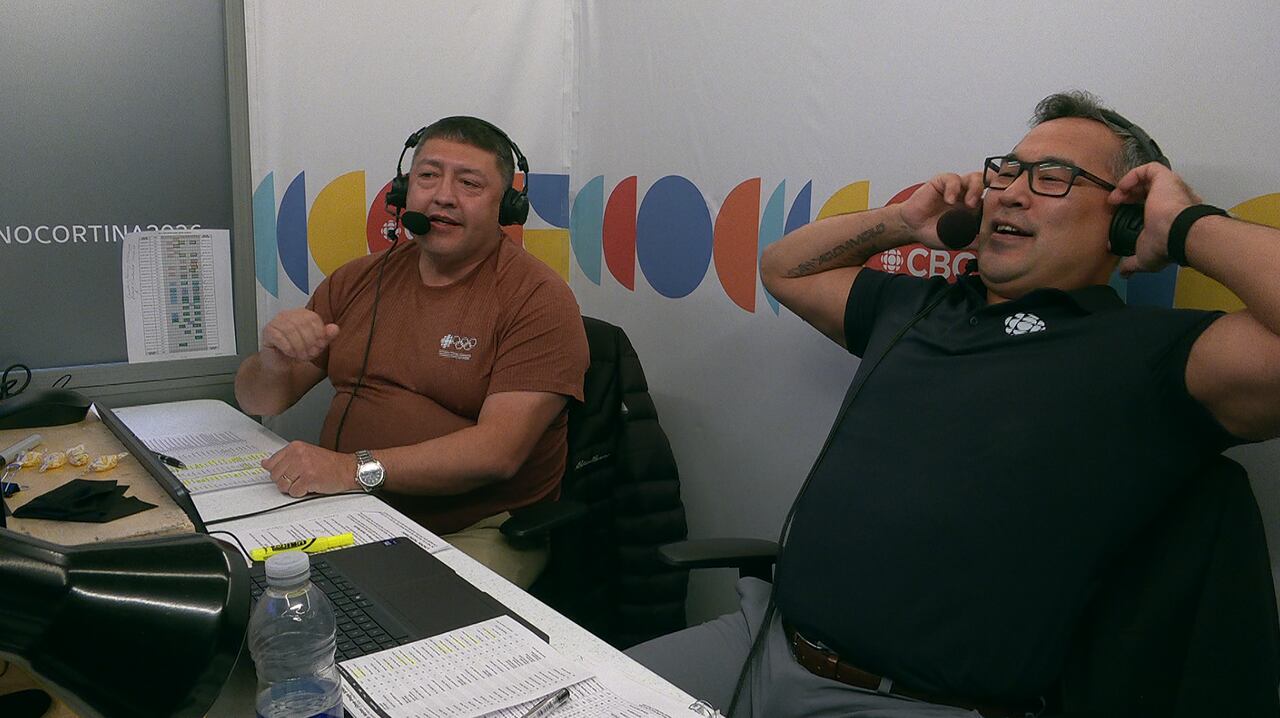
Kusugak and Ningeongan had the opportunity to call basketball for CBC Olympics during the Summer Games in Paris in 2024. (CBC Sports)
“It’s really about contextualizing terms. You can’t translate a word exactly as it is in English,” Kusugak stated.
“For instance, the term for a penalty is ‘Tigujaujuq’ (ᑎᒍᔭᐅᔪᖅ). It’s almost akin to being incarcerated.”
Ningeongan mentioned that translations between Inuktitut and English often vary in length, leading the two commentators to adapt how they discuss various game terms.
“For example, I used to refer to ‘puck’ as ‘Aqsannguaakuluk’ (ᐊᖅᓴᖖᒍᐊᑯᓗᒃ) for a long time,” he shared.
Ningeongan indicated that they decided to consult their audience for a shorter Inuktitut term for puck.
“People responded, saying, ‘We’ve followed hockey for ages, we get what you mean when you say puck, so just stick with that term,’” he said, explaining that they have now adopted the shorter ‘Pak’ (ᐸᒃ).
Icing was another term where Ningeongan noted that the duo sought input from their community for a translation.
Ultimately, they found a suggestion from someone at a local arena to use ‘Sipkutijut’ (ᓯᑉᑯᑎᔪᑦ).
“That name caught on, and that’s what we use today,” Ningeongan remarked.
Involving their community and local viewers in the language development process has ensured that identifying hockey terminology in Inuktitut is not solely reliant on the two of them.
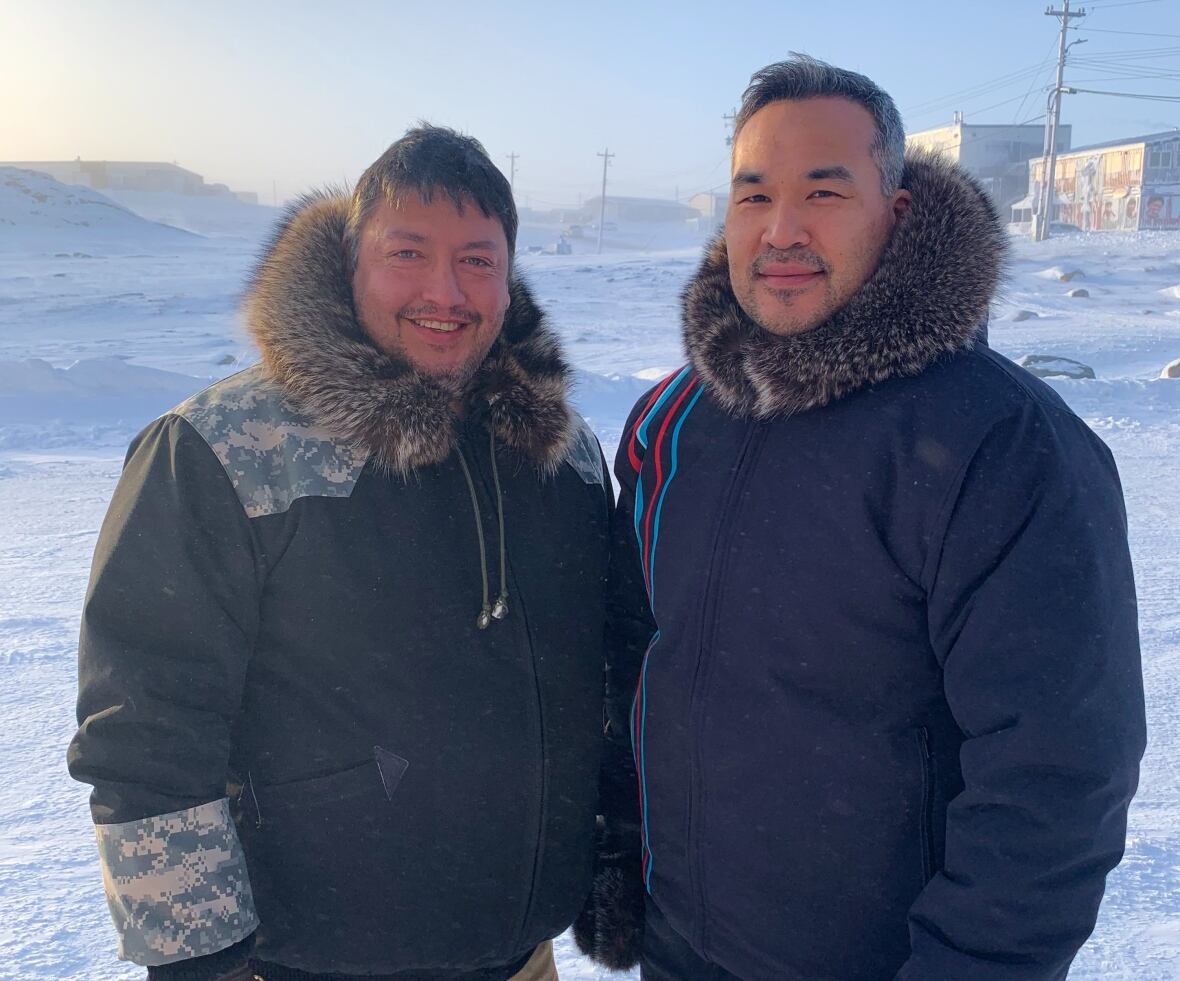
Ningeongan and Kusugak in Rankin Inlet, Nunavut. (Submitted by Pujjuut Kusugak)
“There have been occasions when I’ve quickly texted my mom during a break, asking, ‘Can you suggest a word for this?’ And she’s done that for me before,” Kusugak shared.
Engaging the community during broadcasts has also facilitated learning among viewers who use various dialects or terms, enabling them to share knowledge through the sport.
“We aim to use it as a teaching moment and a learning experience.”
Hockey in the North
Ningeongan emphasized that hockey is deeply cherished in Inuit communities.
Both Kusugak and Ningeongan have participated in the sport beyond commentary roles, serving as coaches and players. Kusugak has played with various minor-league teams, while Ningeongan is recognized as a goalie in Nunavut.
“In previous years, everyone would tune in to Hockey Night in Canada. If you went hunting on a Saturday morning, you made sure to return before the game commenced,” he recalled.
This past year, Kusugak and Ningeongan have contributed to the commentary of several NHL games for Hockey Night in Canada in Inuktitut alongside APTN.
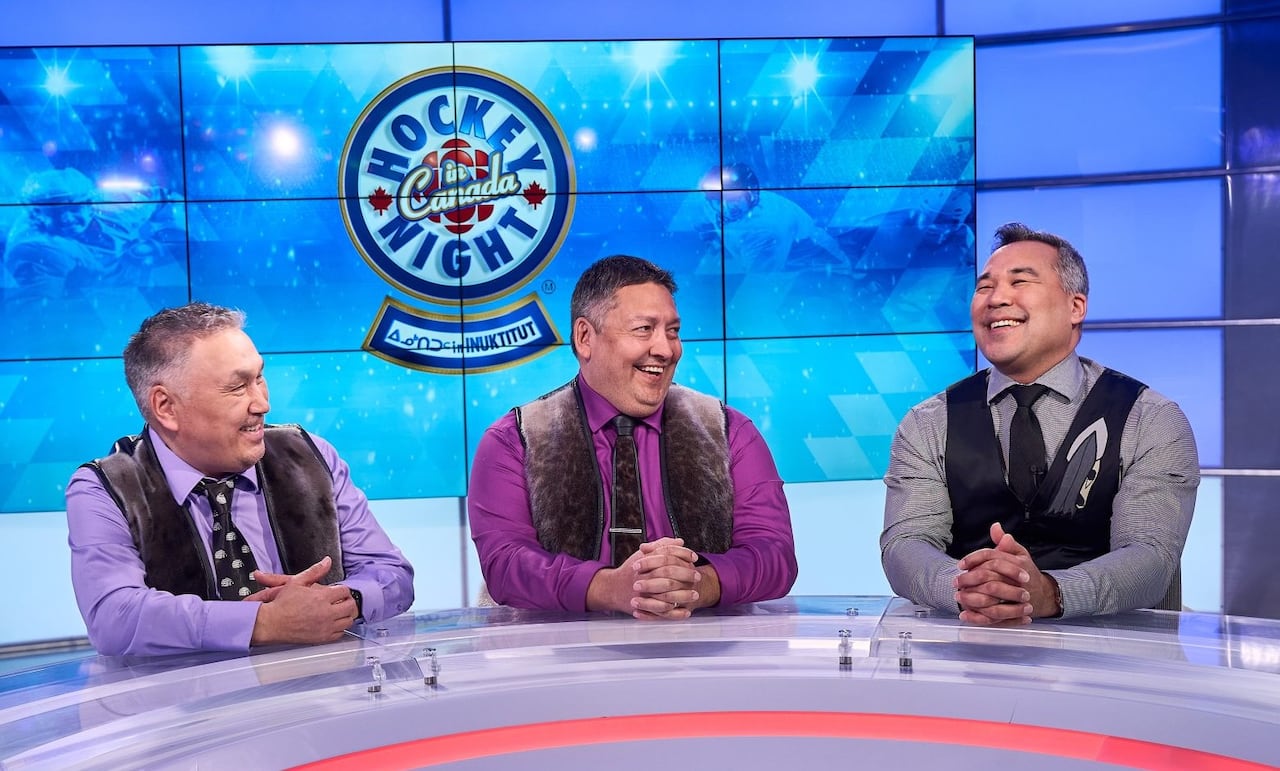
Kusugak and Ningeongan, with Robert Kabvitok, left, were part of bringing Hockey Night in Canada in Inuktitut for APTN last year. (APTN)
Ningeongan highlighted the importance of having their language featured in Olympic broadcasts, especially for the youth in their communities.
“We are losing our language, and we are making every effort to promote Inuktitut so that it remains alive. I hope our efforts contribute to ensuring we continue using our language,” he stated.
Kusugak expressed his desire that their initiatives with the Olympics and Hockey Night in Canada will motivate others to pursue commentary in Inuktitut for various sports or events, even at the local level.
“It has been incredibly meaningful to discuss a sport we are passionate about while using our language, hopefully inspiring others to do the same in the future,” said Kusugak.
“This truly is a dream job.”